Why Your Booth Can Look Right—but Still Not Work
Sometimes the booth looks fine.
The table is covered.
The display pieces are in place.
Nothing seems obviously wrong.
And yet something still feels off.
You step back and think, Why does this look better in my head than it works in real life?
Then the day starts, people glance in, and somehow the booth still doesn’t feel easy to enter, or easy to understand.
It can be frustrating when the booth appears “put together” but still doesn’t create the response you expected.
Because when nothing looks clearly broken, it becomes harder to see what actually needs to change.
If your booth looks good but still isn’t working, you don’t need to redo everything—you need to adjust how it functions.

Craft booth with an open layout where customers can step in and browse comfortably.
The Pattern
A booth can look finished… and still not work.
You don’t want to tear it all down… but you don’t trust it either.
Why This Happens
That usually happens when the maker is judging the booth by appearance alone:
everything fits
the table looks full
the colors feel cohesive
the display pieces match
the setup seems finished
But customers do not experience the booth as a still image.
What looks complete to you doesn’t always translate into something usable for the customer.
They experience it as movement—moment by moment.
They walk by.
They scan quickly.
They decide whether it feels approachable.
They try to understand what you sell.
They look for a place to pause—
without feeling crowded or trapped.
So a booth can “look right” to the maker because it appears complete, while still not working for the customer because the booth experience itself is unclear.
The Cause
What usually breaks here is not effort.
It’s structure.
Here are the patterns that usually show up when a booth looks right—but doesn’t work:
A visually pleasing booth can still struggle when one or more of these problems are present:
1. The booth has no clear entry point
(customers don’t know where to begin)
If customers cannot tell where to begin looking, they keep moving.
A setup that feels balanced to you may still read as closed, flat, or uncertain from the aisle.
2. The eye lands everywhere at once
When every area asks for equal attention, nothing stands out.
The booth may look full and thoughtfully arranged, but the customer never receives a clear first impression.
3. Product grouping is decorative instead of directional
Items may be arranged attractively, but not in a way that helps people understand categories, price relationships, or what kind of work you actually sell.
4. The setup protects symmetry more than shopping flow
Sometimes makers keep things visually even because it feels safer or more polished.
But symmetry does not always create movement.
In some booths, it actually flattens the experience and removes natural points of curiosity.
5. The booth is readable only after effort
If a customer has to work to understand what they are seeing, many simply won’t.
A booth does not need to be loud, but it does need to become clear quickly.
The Constraint
This is what makes booth problems hard to solve.
Most makers adjust based on what feels visibly wrong:
too empty
too cluttered
too plain
too busy
But when the booth looks “basically good,” the real issue often hides underneath those more obvious categories.
That is why you can keep tweaking small details without fixing the actual problem.
You change riser height.
You move a sign.
You add another crate.
You remove a basket.
You shift products around.
And still, the booth behaves the same way.
Because the issue was never just how it looked.
It was how it worked.

Working on a Booth Layout That Doesn’t Feel Settled Yet
The Shift
The question to ask isn’t:
Does my booth look right?
The better question is:
Does my booth help people know:
where to look,
where to move,
and why to stop?
That shift matters because a working booth is not just a styled space.
It’s a readable environment—one that makes sense without effort.
A strong booth usually does three things well:
it gives the eye somewhere to land first
it gives the customer a clear way to enter and browse
it makes the products easy to understand without effort
When those things are missing, the booth can still look attractive while quietly underperforming.
And that underperformance often gets misread as a sales problem, a product problem, or even a confidence issue.
Sometimes, it’s simply a structure problem.
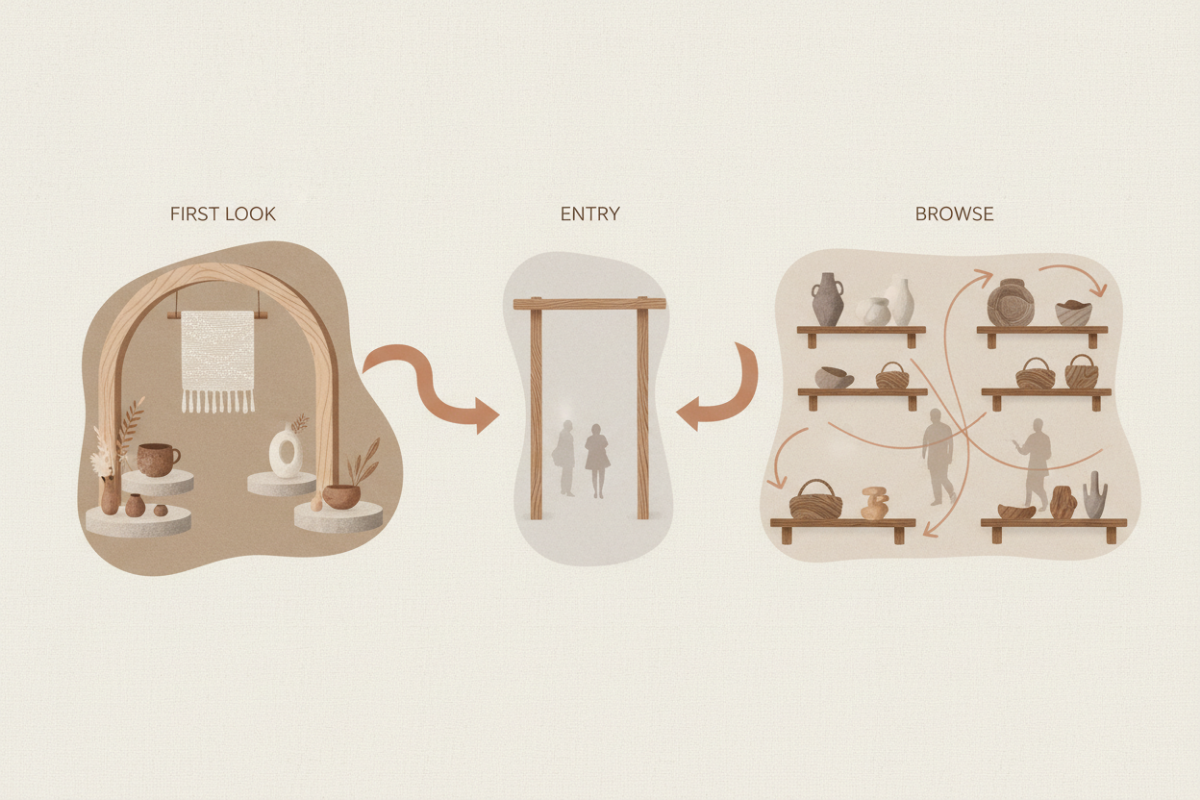
How Customers Move Through a Craft Booth
Structured Change
Here are four ways to check whether your booth is only looking right—or actually working.
These aren’t design tweaks—they’re structure checks.
1. Check the first three seconds
Stand outside the booth and look at it the way a passing customer would.
Ask:
What do I notice first?
Is there one clear focal point?
Do I immediately understand what kind of products are here?
Does this feel open enough to approach?
If the booth isn’t clear within a few seconds, it may be visually fine—but functionally weak.
2. Check whether the layout creates entry
Look at the front edge and center of the booth.
Ask:
Is there a visible opening?
Does anything feel like a barrier?
Are display pieces creating hesitation instead of invitation?
Does the booth feel easy to step into with the body, not just the eyes?
Many booths look organized—but unintentionally block entry—through tight spacing, hard front lines, or overfilled front tables.
3. Check whether products are grouped for understanding
A customer should be able to make sense of the booth in sections.
Ask:
Are similar items grouped together clearly?
Can someone tell the difference between categories quickly?
Does each area help the customer understand something—or just fill space?
Is the arrangement helping the customer make decisions?
Pretty arrangements can still create confusion when the grouping logic is not obvious.
4. Check whether the booth supports movement
A working booth has rhythm.
Ask:
Where does the eye move after the first focal point?
Is there a natural next place to look?
Do height changes create interest or just busyness?
Is the booth guiding browsing, or scattering attention?
If movement feels random, the booth may look complete—but won’t support real browsing.
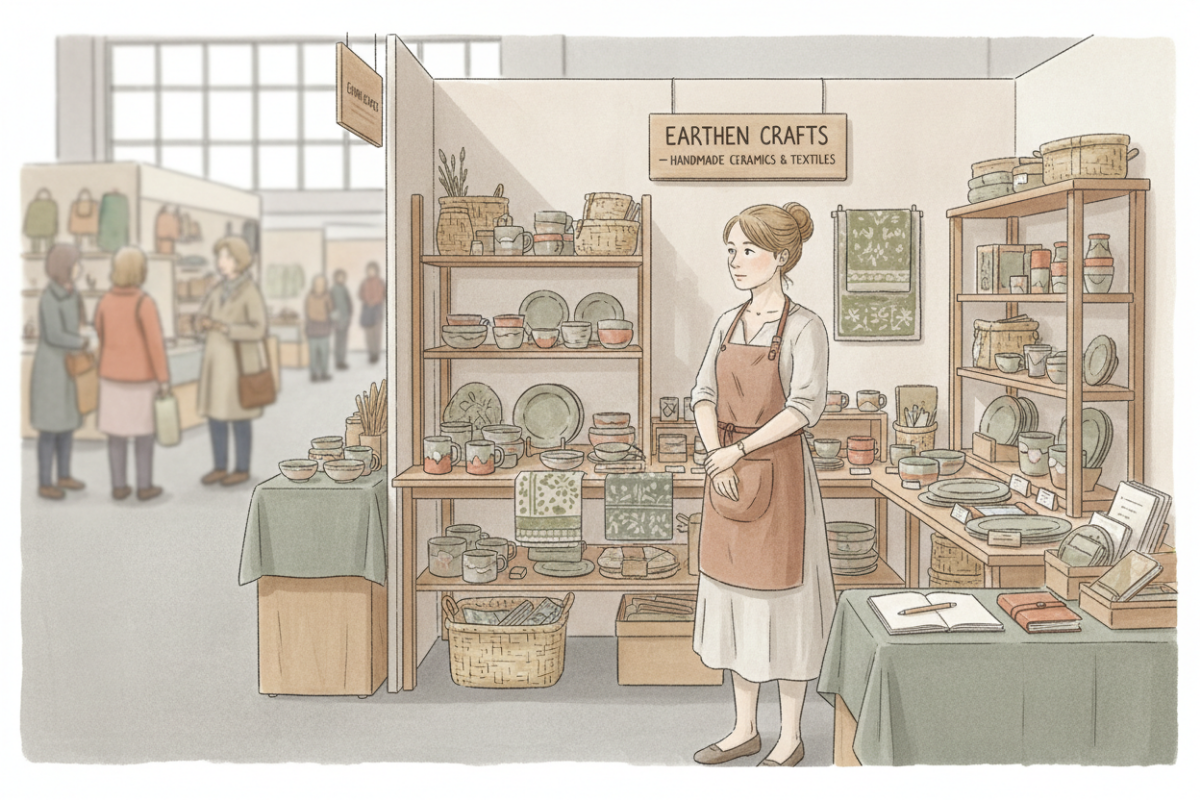
When a Booth Looks Finished but Still Isn’t Working
The Decision
If your booth has been feeling close—but not effective—the problem usually isn’t that it looks bad.
It may be that the booth is asking the customer to do too much work.
That’s a different problem.
And it needs a different kind of fix.
And once you see it that way, the next step becomes much clearer.
If you’re ready to fix what’s actually causing the problem, start here: