

A Disappointing Show—or Season—
Can Start to Feel Like a Verdict
on Your Work—or Yourself.
The Show Is Over
The Result Is Still With You

You packed the booth, got in the car, and started replaying the day.
Maybe shoppers passed without stopping. Maybe sales were lower than expected. Maybe the whole season left you wondering what you missed.
The hardest part isn’t always what happened.
It’s how quickly one result can become a conclusion about your booth, your work, or whether you should keep going.
When It Starts Feeling Personal gives you a place to slow down, examine what happened, and look at the evidence before disappointment decides what the result means.
One result can matter without telling the whole story. ✦
Evidence helps separate what happened from what it seemed to mean. ✦
A thoughtful next step begins with seeing clearly. ✦
One result can matter without telling the whole story. ✦ Evidence helps separate what happened from what it seemed to mean. ✦ A thoughtful next step begins with seeing clearly. ✦
A Clearer Read on What Happened
-
What Happened
What can you describe without judging it?
Separate what you observed from what you assumed, feared, or concluded. Begin with the result itself before deciding what it means.
-
What Shaped It
What else may have influenced the result?
Look at the show, audience, booth, shoppers, products, and your own experience. More than one condition may have been at work.
-
What Repeated
Is this one moment—or part of a pattern?
Compare what happened across shows and seasons. Repetition strengthens a conclusion; one difficult result may not.
-
What Comes Next
What genuinely deserves your attention now?
Decide what to keep, watch, change, or release—without letting urgency turn disappointment into an unnecessary overhaul.
WHAT THIS HELPS YOU DO
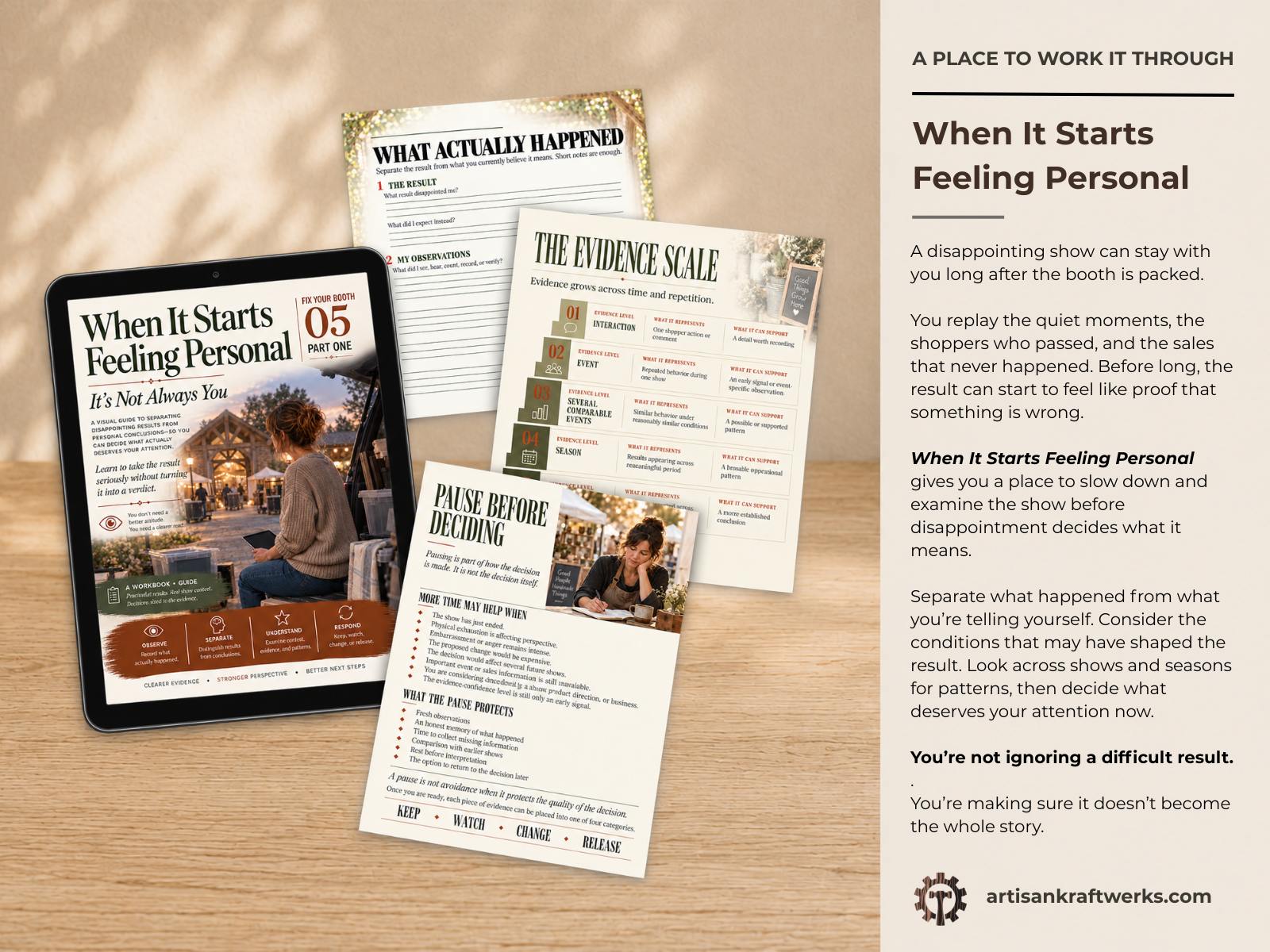
It’s easy to leave a disappointing show and begin replaying everything that went wrong.
A quiet booth, lower sales, or a difficult season can quickly start to feel like proof that something is wrong with your work—or with you.
This workbook helps you slow that conclusion down. Instead of treating one result as the whole story, you’ll separate what happened from what you fear it means, consider the conditions that may have shaped it, and look for evidence across more than one moment.
Then you decide what the result actually deserves.
You’ll learn to distinguish a difficult moment from a developing pattern, recognize progress that disappointment can hide, and identify what is worth keeping, watching, changing, or releasing.
The goal isn’t to explain away a disappointing result.
It’s to understand it clearly enough to make your next decision with evidence—not urgency.
A Few Things You May Be Wondering
-
It may have been. This workbook isn’t designed to excuse a disappointing result or convince you that nothing needs to change. It helps you examine the booth alongside the show, audience, shoppers, products, and other conditions so any change you make is supported by evidence.
-
Both. You can use the workbook to examine one result closely or look across several shows for repetition. The goal is to determine whether you’re seeing an isolated moment, a possible pattern, or something established enough to guide a decision.
-
No. The workbook is divided into two parts so you can move through it at a thoughtful pace. Work through the sections that match what you need now, pause when necessary, and return when you have more information or perspective.
-
This is a digital product delivered as two printable US Letter PDF files. You can print the pages you need or use them with a PDF annotation app. You’ll also receive access to the Companion Library with reusable tools and additional printable pages.
Ready to Take a Clearer Look at What Happened?
When It Starts Feeling Personal helps you examine a disappointing show before one result becomes a verdict about your work—or yourself.
$12.99 • Digital download • Use at your own pace • Purchase and delivery through Etsy